Ergodicity
Today, let us steal a word from physics. The University of Houston presents this series about the machines that make our civilization run, and the people whose ingenuity created them.
______________________
The word that I chose to steal is Ergodicity. An ergodic system is one whose behavior will give us the same answer if we average it all at once or over time. Imagine two people playing poker. If the game’s ergodic, that means the time average of all games they play, will be the same as the average of all possible games – well, as long as the players can’t go bankrupt.
Better yet, imagine that you’re an efficiency expert trying to learn whether charging extra for a second cup of coffee in a crowded diner would keep diners from lingering at their tables. So you identify ten customers and you track them.
But wait a minute. Wouldn’t it be smarter to photograph all the customers from a balcony? Then see who’s eating and who’s sipping coffee. Of course it would be. IF patrons were ergodic – if what each did over time was the same as you see in an instant. But there’s a catch:
Some patrons are managers who’ve come to talk things over in a leisurely way. Some are workers with a short lunch hour. The poorer wage earners might simply not have time for extra coffee. Our two efficiency experts will disagree, since the system is not ergodic. They would agree only if it were ergodic.
So: why is this important in physics – specifically, in thermodynamics? Take stationary air: It’s a vast set of molecules bouncing off one another. The history of any one molecule – its various speeds and trajectories – will mirror the instantaneous speeds and trajectories of all the molecules right now. Static air is ergodic.
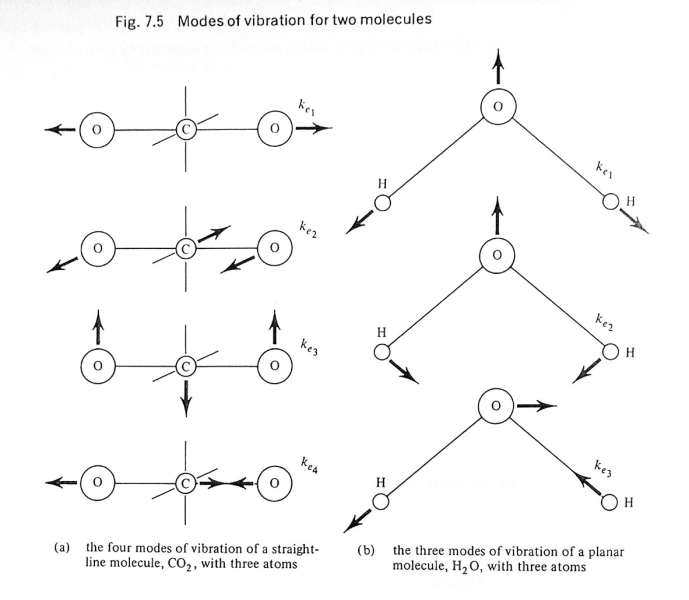
Just one part of the possible complexity of ergodic molecular behavior in CO2 and water vapor (From the first reference below)
But what if we reset our thermostat to a higher temperature. Now, for a while, molecular speeds are increasing. And, for now, the air is no longer ergodic. So back to our physicist friends. They use a science called statistical thermodynamics. It lets us learn all kinds of physical properties of ergodic substances from their molecular structure and behavior.
But you and I are not physicists. So where does all this touch our lives? Take social relationships: They’re very non-ergodic. That’s because, say, the average quality of a new relationship begins at a kind of ground zero. But a long-term relationship with just one of those people is usually one that grows more fulfilling. So: Don’t expect to find ergodic human relationships.
For that matter, think about art – about songs, poems, paintings – all reach toward, but never quite reach, a perfect ergodic state of completion. Ergodicity is useful in describing completed end-states. But that places it outside of human experience. If I may quote poet A. E. Houseman: “The tree of man is never quiet.”
I’m John Lienhard, at the University of Houston, where we’re interested in the way inventive minds work.
(Theme music)
For more on ergodicity, see, C. L. Tien and J. H. Lienhard, Statistical Thermodynamics, Hemisphere Publishing Co., Washington D.C. 1979, 1971. Chapter 8. Click here to read this book, free of charge, online. (This textbook treats that science, by and for, engineers.)
Click here for examples of ergodicity in everyday life.
This Episode first aired on June 2, 2026.