Calligraphic Art
Today, when handwriting became art. The University of Houston presents this series about the machines that make our civilization run, and the people whose ingenuity created them.
______________________
I marvel at a small ink drawing that was made in the late 1860s in New York State by a student named S. E. Backus. An elegant swan emerges from a flurry of curving lines of blue, pink, and gold. Each of those lines is actually a component of the cursive handwriting system taught to business students in the nineteenth century.

Swan, by S. E. Backus in an autograph album in the collection of the Kitty King Powell Library and Study Center, Bayou Bend Collection, Museum of Fine Arts, Houston.
Long before typewriters, let alone computers, all legal and business records had to be written by hand. As America expanded in the 1800s, each new county and town produced countless handwritten deeds, tax records, and other essential documents. Every business required handwritten account books and receipts. Bad handwriting could cause legal problems or affect the bottom line. An army of clerks who could produce a standardized, legible form of writing was badly needed.
The first American schools devoted to business education were founded in the 1820s. By the late 1860s, when Backus was creating his swan in colored ink, hundreds of business schools dotted the country, and all of them included penmanship in their required courses. Today, we would describe the handwriting they taught as “calligraphy,” from the Greek for “beautiful writing.” But, at the time it was treated as a means to consistent record-keeping rather than art. Backus studied at the Eastman National Business College, in Poughkeepsie, New York. He owned a small autograph album that many of his classmates signed, but he used the blank pages to draw the swan and other birds using the skills he learned in his penmanship classes.
Penmanship instruction of the time emphasized repetitive copying of letter forms. Those movement drills, as they were called, relied on a system called “muscular movement,” where a back and forth rolling movement of the forearm muscles guided the pen. Students spent at least an hour each day practicing in class, with every element of each letter isolated and repeated. It’s hard to imagine how such regimentation could lead to our swan, but it did.
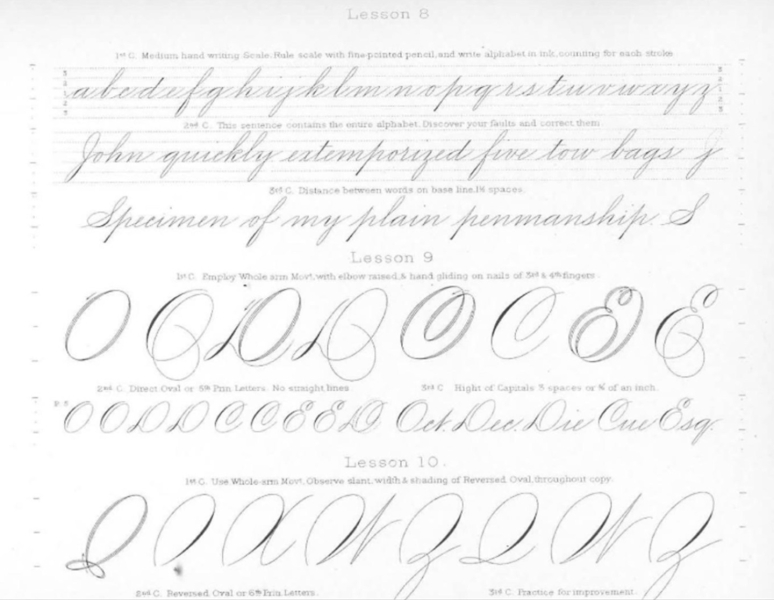
Sample page from the penmanship manual titled New Spencerian Compendium, published in 1879. The entire work can be accessed on the Internet Archive.
After mastering all the elements of cursive writing, students could then move on to the art of flourishing, using the curving elements that formed letters to make purely decorative embellishments or drawings like Backus’s swan. The range of subjects and their execution was as varied as the skill and imagination of their creators. Backus included a swan and five other birds in his album. Penmanship masters produced large-scale flourished drawings to advertise their skill.
In the process of training a workforce for American offices, business colleges ended up giving talented students the tools they needed to create delightful decorative works.
Artists are always among us, whether they graduate from famous art academies or business schools. Throughout history, those with vision and skill have used traditional tools and materials to make exceptional works—whether in the form of painted canvases, quilts, or even calligraphic swans.

Dove by S. E. Backus in an autograph album in the collection of the Kitty King Powell Library and Study Center, Bayou Bend Collection, Museum of Fine Arts, Houston.
I'm Margaret Culbertson at the Museum of Fine Arts, Houston’s Bayou Bend Collection, where we too are interested in the way inventive minds work.
(Theme music)
Bibliography:
Selected pages from the S. E. Backus album have been digitized and can be viewed in the MFAH Libraries and Archives Digital Collections. https://librariesarchives.mfah.org/digital/collection/manuscripts/id/326/rec/5
The complete album can be viewed at the Powell Library. Hours and directions at the following link: https://www.mfah.org/learn/powell-library
Henning, William D. An Elegant Hand: The Golden Age of American Penmanship & Calligraphy. Newcastle, Delaware: Oak Knoll Press, 2002.
Thornton, Tamara Plakins. Handwriting in America: A Cultural History. New Haven, CT: Yale University Press, 1996.
New Spencerian Compendium, published in 1879. Available on the Internet Archive: https://archive.org/details/NewSpencerianCompendium/page/n75/mode/2up
This Episode first aired February 24, 2026.