Tin Cans
Today, let us make tin cans. The University of Houston presents this series about the machines that make our civilization run, and the people whose ingenuity created them.
______________________
Long ago, when I spent some time in the US Army, we dreaded days when we had to eat C-rations. C for Combat. These were field rations meant for troops out of reach of a mess hall. Tin cans full of artificially-flavored foods.
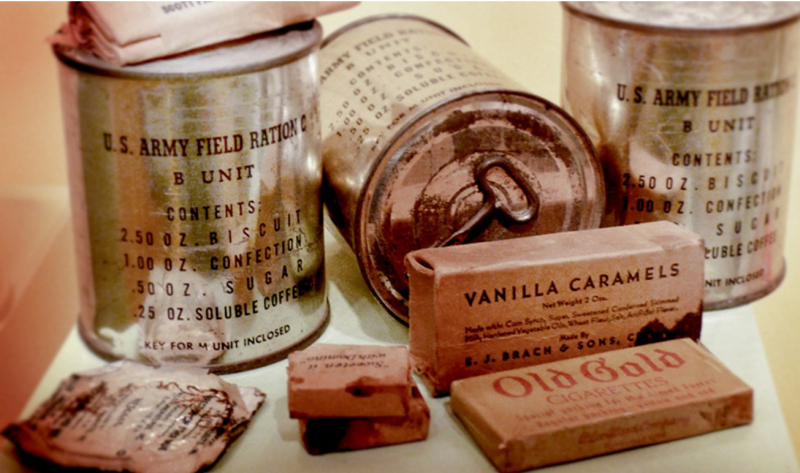
C-Rations
I should qualify that tin can remark since tin cans are generally steel, coated with tin. Late eighteenth-century Dutch had learned that tinned containers were food-friendly. They’d been packing fish in containers made of tinned wrought iron.
Then Napoleon’s armies, like armies ever since, had to be fed in the field. So, a French confectioner showed how to provide him with bottled food. Soon after, another French inventor patented tin can food preservation that was sealed far more completely than Dutch tins had been.
But manufacturing issues kept sealed tin cans from reaching the general public until the late nineteenth century. Even then, it took the need to feed combat troops in World-War-I to finally make the practical tin cans that we would recognize today.
Today, tin cans are ubiquitous. But they’re not free of problems. Many offer foods that are heavy in salt, since salt is an easy means for preventing spoilage.
Then there’s the problem of opening tin cans. And here we faced a whole new set of issues. A well-sealed can took tools to open. At first, one was at the mercy of domestic tools – chisels, hammers, and such. Eventually, can manufacturers offered help – like cans with twist keys.
The first hand can-openers followed in the mid-nineteenth century. They took three forms. One was the lever-type that lets us puncture a can, then work our way around the rim, levering the cut a half inch at a time. The other was a key-turned rotating wheel which, once it’d punctured one spot could continue cutting all the way around. Finally, the “church key” type. It just makes a single triangular hole in a can full of liquid.

A “church-key” type of can opener
Then, starting in 1931, the first electric can opener hit the market. And it’s been followed by a dizzying series of “improvements” ever since. I use one now and then. But I’m not shy about picking up my old-fashioned mechanical ones in its place.

A 1931 can opener patent
And I’m back to those accursed C-rations. You don’t want soldiers searching for a can opener on a battlefield. So, we were equipped with a tiny specialized can-opener that rode around our neck, next to our dog tags.
Well, I find myself approaching lunch time. And, once again, I face that ultimate decision. Should I cook a proper meal? Or should I open a can? I really won’t know the answer until I reach the kitchen.
I’m John Lienhard, at the University of Houston, where we’re interested in the way inventive minds work.
(Theme music)
About C-Rations: C-ration - Wikipedia
About canning: Canning - Wikipedia
History of the can opener: Can opener - Wikipedia
Images are courtesy of Wikimedia Commons.
My thanks to Jacinta Carlson for suggesting the topic
This Episode first aired on February 23, 2026.