1906 Shop Notes
Today, a manual tells us more than it means to. The University of Houston presents this series about the machines that make our civilization run, and the people whose ingenuity created them.
______________________
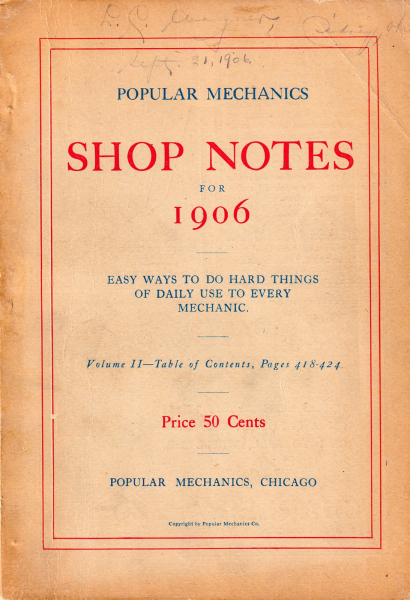
Popular Mechanics put out books of Shop Notes, back in 1906. I have one here, and it’s a strange document to our eyes. Its hundreds of tips on how to do this or that provide a stark reminder of how much our technology has been black-boxed.
The machinery of our everyday life largely lives in containment that we never open. Just imagine opening an iPhone to make repairs! Back in Henry Ford’s day, a driver could open a hatch in the floor of one of his old Model Ts. He could not only see what was wrong with its transmission. He could fix it as well.
This manual assumes that everything out there should be handled, modified, and tinkered with. How to wind an armature. How to rig an alarm clock to ring a bell. How to protect an electric motor from dust. How to build our own jack, if we need to lift something heavy.
This was before neon signs. Neon was still new when I was a child in the 1930s. We we’re in awe of it. But here we see how to spell out our message by drilling holes in a metal sheet. Then lighting it from behind with those new electric light bulbs.

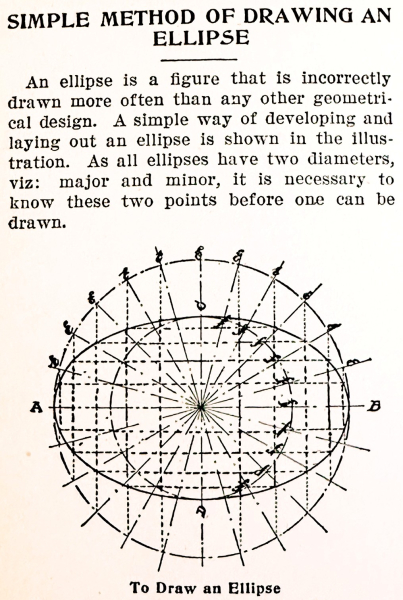
Here’s one I had to look up: How to cure Felon. Felon? No, not a criminal, but a forgotten word for a fingernail infection. You cut a hole in an egg, insert your finger and sleep with it overnight. I also find a couple of instructions for drawing an ellipse -- things I used to teach when I was a drafting instructor long ago. Engineering schools had quit teaching drafting by the 1990s.
We see how to hitch our bicycle to a small electric generator, so we can power a light bulb. (You might remember Edward G. Robinson doing exactly that in the movie Soylent Green.) It’s wildly impractical. It takes serious exercise to light a bright light bulb.

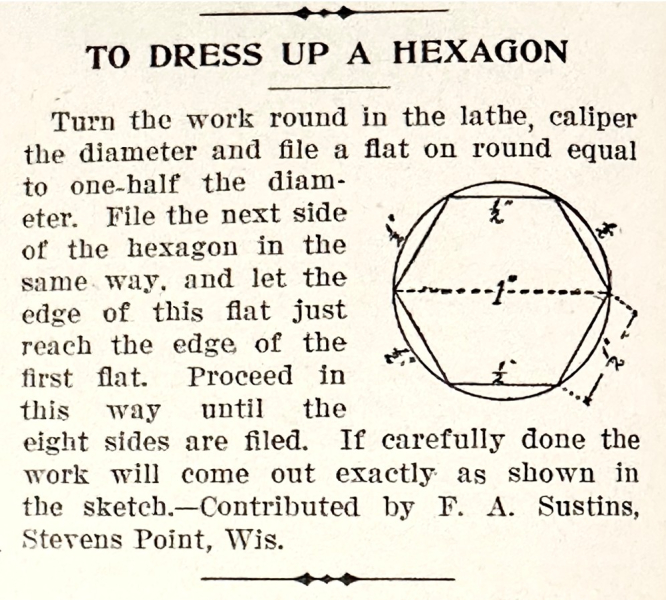
Most items in this old book are true to the title – they’re techniques for handling minor problems that arise in a work shop. Problems that you or I would never have thought of. Like how to turn a heavy metal rod into one with a hexagonal cross-section. That might sound silly. But it lets us get a better grip on it, if we then forge it into a tool.
I actually made such tools in an engineering course called Forging and Welding. That was still part of the 1950s engineering curriculum.
You and I see enormously rapid technological change in our century. But it’s not unique. Here, a strange old book shows us life at the dawn of the last century. And it has no inkling of change about to arrive. The difference between technology then and technology today could rival what we see going on around us.
I’m John Lienhard, at the University of Houston, where we’re interested in the way inventive minds work.
(Theme music)
Shop Notes for 1906: Easy Ways to do Hard Things of Daily Use to Ever Mechanic. Popular Mechanics, Vol. II, Chicago, 1906. (Price 50 cents.)
Engineering drawing - Wikipedia
This Episode first aired on March 17,2026.