More Than Just Hinges
Today, we begin with a simple door hinge. The University of Houston presents this series about the machines that make our civilization run, and the people whose ingenuity created them.
______________________
I recently wondered when we invented the hinge that lets our doors swing open and shut. It turns out that we first swung doors that had a shaft along one side. It fit into sockets on the floor and ceiling. And it found wide use, five thousand years ago.
But the familiar so-called “side-mounted” hinges – with one piece on the wall and one on the door: They’re more recent – just over three thousand years old. They spread rapidly and they found uses in other machinery – like, say, the drawbridge.

All that got me thinking about rotation. Rotation has always meant a conceptual leap. Seventy thousand years ago, our early ancestors had cutting tools, bows and arrows, and much more. Yet they didn’t have the wheel until much later – until shortly before Egypt’s great pyramids.
So: think about rotational implements. Take potter’s wheels, first spun by hand. They appeared about the same time that we had wheels for vehicles. The drop-spindle for turning wool into thread – it’s maybe nine thousand years old. I could go on.
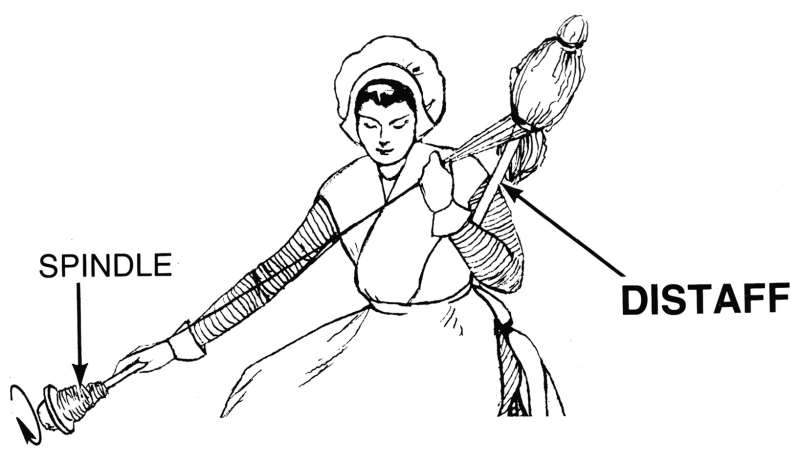
Why, then, was rotation such a conceptual hurdle for us humans to make? Why did it arrive so late in time? The answer is that so much invention simply extends what our bodies can already do. A spear does more than a mere fist. Snowshoes make more of our feet. The sling improves upon our throwing ability. The knife does what our teeth cannot. Fire takes over where our metabolism runs out.
But our bodies are utterly incapable of any continuous rotation. Our joints can turn maybe a hundred-and-eighty degrees. The only living things that use continuous rotation are microorganisms, propelled by a spinning appendage called a flagellum. But our visible bodies that we’re aware of are what informed our early human technology. And it was very late in our existence that we overcame that limitation.
It was only toward the end of our Stone Age that we finally began making rotary technology. Like, say, a child’s spinning top. Tops appeared in King Tut’s tomb, and they turned up in the Near East somewhat earlier.
So, I began by thinking about the hinge. But its pivoting is limited much as our arms and legs are limited. It seems that the very item that began my thinking about rotation had only to wait until people invented the door. The hinge arrived when it was needed. And it did not have to wait for us to wrap our thinking around it.
But unlimited rotation! That has clearly been a mental hurdle. We had to rethink motion itself to invent the wheel. We limited humans! We’ve managed to wrap our heads around rotation only since the era of recorded history.
I’m John Lienhard, at the University of Houston, where we’re interested in the way inventive minds work.
(Theme music)
Some Sources:
Spindle (textiles) - Wikipedia
Human body part rotation: Anatomical terms of motion - Wikipedia
Video about ancient tops: Bing Videos
For paleolithic inventions, see: Paleolithic - Wikipedia
Just for the fun of it, here is a video about how we spun a top during my childhood in the 1930s: Bing Videos
Images courtesy of Wikimedia Commons.
This Episode first aired on March 16, 2026.