Burning Zinc
Today, we burn Zinc. The University of Houston presents this series about the machines that make our civilization run, and the people whose ingenuity created them.
______________________
I have here the first issue of Science Magazine. Dated July 3, 1880. Thomas Edison was its first underwriter. He was in some financial trouble, and hoped to gain public support from the magazine. Turns out, the magazine got no traction, and it folded. Then, two years later, Alexander Graham Bell helped to underwrite its revival.
From then on, it rather limped along until the American Association for the Advancement of Science took it over. And it’s survived ever since. So, let’s open this first, Edison-friendly edition. And we find an odd article: “Electricity as Power.”
Back then, we knew enough to build a motor driven by electricity. But we need a machine that goes the other way – one, driven by a steam engine, which produces electricity. We call that machine, a dynamo.
Dynamos had only just been invented. And this author begins by showing why electric batteries won’t work. Today, we use far better batteries. And they power all kinds of electronic equipment and small gadgets. We even use batteries to power our cars, and to provide short-term backup to our homes. But a battery must soon be recharged. For sustained use, we need to generate large-scale, continuous power. We need those dynamos.
So this author begins with Zinc – the essential element in batteries back then. And it remained so into the next century. Zinc gets charged when it’s smelted from ore, and it gets consumed chemically, as it yields electric energy – as it turns back into grey dust. So the author likens burning Zinc to burning coal. “The fires are fed by burning metal” he says with a flourish!

Contemporary Zinc Battery
He recognizes that we empower zinc when we smelt it from ore. Then, in his words, we burn it up again, as we use its electric energy. He concludes that it’s far more cost effective to burn coal. That’s hardly a surprise for us. But it drove home the need for those new dynamos. And here we’re back to Edison.
Edison didn’t invent the dynamo. But he had, by then, created the first large energy distribution systems to power his new light bulbs. And here, the magazine provides free promotion of his system. All that talk about batteries looks like a mere “straw man” to knock down, before he gets to Edison.
He also talks about a system in which a locomotive might pick up electricity from wires along a track. What we came to know as the trolley system. And it survives today in many cities, world-wide.
This strange old piece of Edison promotion is, at once, prescient and sloppy. It’s laden with both spelling errors and hyperbole. And yet, this temporarily doomed magazine gives us a fascinating look into the history of America’s electrification.
I’m John Lienhard, at the University of Houston, where we’re interested in the way inventive minds work.
(Theme music)
Francis P. Upton, Electricity as Power. Science: A Weekly Record of Scientific Progress. July 3, 1880 (Full article shown below)
I have not mentioned a very important sidelight in the text above. It is that Edison’s dynamos produced direct current. A long battle with Westinghouse and Tesla ensued. Westinghouse built alternating current generators which proved to be far superior, and which we use today. For details, see: War of the currents - Wikipedia
Dynamo | The Engines of Our Ingenuity
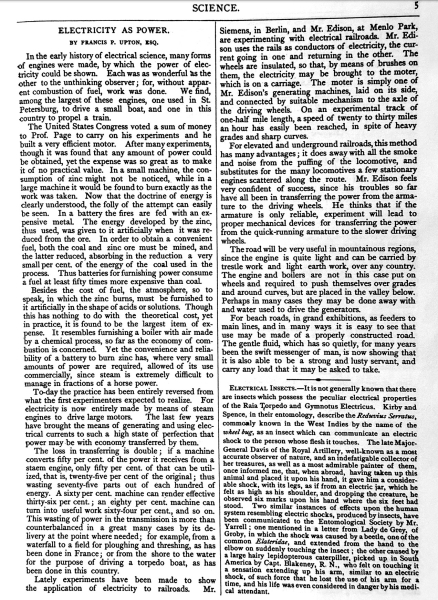
Click the image to view the full article.
This Episode first aired on May 20, 2026.