Circus
Today, we welcome new faculty. The University of Houston presents this series about the machines that make our civilization run, and the people whose ingenuity created them.
______________________
I’m thinking about new faculty beginning the adventure of university teaching and research. And, as I do, I remember back when I was just fourteen. I got up at four in the morning and bicycled out to the fairgrounds where the circus had come to town. They snatched me up – put me to work setting up bleachers. I finally limped home that afternoon with free passes for the evening show.
What I saw that day was magical, even before the actual show. A tutorial on applied mechanics. First, seeing six men with sledgehammers, circling an anchor post – six men raining down blows with machine-gun rhythm. Sinking each post in seconds.
Then the erection of a two-hundred-foot-high tent with tensioned ropes. This could never’ve been done without delicately balancing huge forces. The synchronization. The cooperation. It was a ballet performance. And all that was just preamble. That night, tired and achy, I watched the show!

The Coming of the Clowns
Again, it was discipline and applied physics. You know what I mean. You’ve all seen trapeze artists, high wire acts, stilt walkers, the athletic antics of clowns. All making the impossible seem easy. Their mathematical precision coupled discipline and danger. The penalty for error was severe.
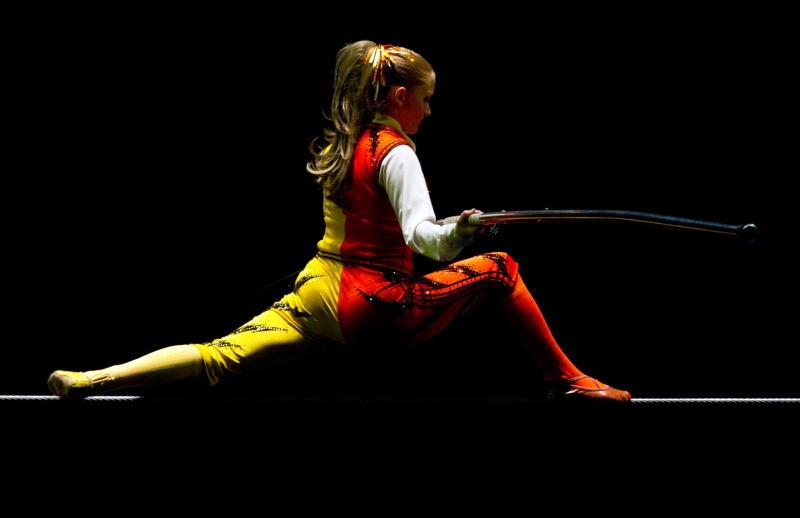
Tightwire Act with Balance Pole
Fast forward: No longer fourteen, I’m twenty-five and teaching machine design at a university. Each day I must have complex ideas under control. Then I must make them understandable. If I fail, the students will not overlook it. I need to stay on my own tightrope.
There’s more: Teaching is where we hone our balance, but without ever shortchanging our students. Then, a serious high wire act comes when we put our own newly forged ideas before the most critical audience: The judgement of our new ideas by our peers. A lapse of logic or a lazy idea means a serious fall from our own trapeze.

Aerial Straps, Hand-to-Hand
Of course, there’s also the delight in having shared knowledge – whether it’s already known, or new knowledge that we’ve created. The delight in having done so and succeeded. Our students tell us when we’ve managed to ride that bicycle across the wire. Not by applause, but by understanding. Our peers tell us if we’ve really created new knowledge. Not by gasps of excitement, but by making use of our work.
I’m sure you’ll find your own metaphor for the academic life. But mine began taking shape during my labors that day, over eighty years ago. A time when a wildly varied group of focused people turned a dusty field into a lecture on our capacity for creating magic. It was a moment when I saw how expertise, and mutual trust, lets us achieve that which, at first, did not seem possible.
I’m John Lienhard, at the University of Houston, where we’re interested in the way inventive minds work.
(Theme Music)
An Interview with a Circus Performer | 47Magazine & Media
10 Types of Circus Jobs (With Salaries and Duties) | Indeed.com
Here is a contemporary example of four (not six) men pounding a stake in much the same way as I witnessed:
https://www.jukinmedia.com/licensing/view/14927-1?utm
My Circus Photos. All photos are from this set.
This Episode first aired on December 22, 2025.