Scissors
Today, let’s look at scissors. The University of Houston presents this series about the machines that make our civilization run, and the people whose ingenuity created them.
______________________
We engineers like levers. Ancient engineering made great use of them – of levers and the fulcrums around which they rotate. As Archimedes said, “Give me a lever long enough, and a fulcrum on which to place it, and I shall move the world.” A small weight, far from a fulcrum, can lift a large weight near it – a teeter totter with a small kid far from its balance point, lifts a grownup sitting near that pivot .
Scissors are like that. Consider one blade as the ground and the other, the teeter tooter. As a matter of fact, many other instruments are kin to scissors – pliers, pruning shears, tin snips, bolt cutters ... So: How old are scissors?
And here things get interesting. You see, the first scissors didn’t use leverage. Four thousand years ago, the Mesopotamians bent one piece of metal into two blades that sprung apart. To cut, you’d squeeze them together. No advantage of leverage.

Roman shears from Trabzon, Turkey, 2nd Century AD. These are spring-loaded with what is actually a leverage disadvantage. Image courtesy of Wikimedia Commons.
Europe used those spring-mounted scissors well into the Middle Ages. And, we know that the Chinese also used them in those years. It was probably the Romans who first thought of mounting two separate blades on a hinge. I say might’ve been, since the Japanese or Chinese also had that idea.
So, let’s look at our own scissors. You’ll see that their pivot point, or fulcrum, is several inches away from where our fingers squeeze the handles. But the blades: They first cut, a fraction of an inch from the fulcrum. They bite right into a tough item at first. We lose that leverage as we close the scissors – as the cutting takes place further from the fulcrum.
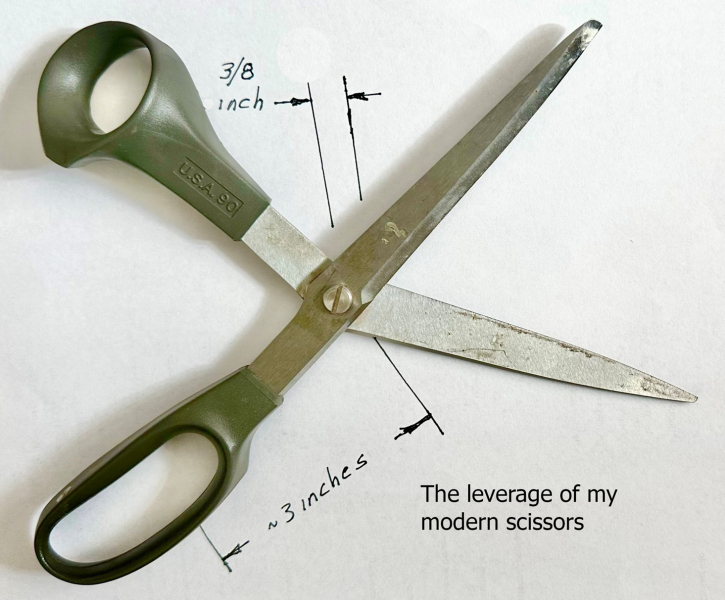
My scissors. Showing their leverage advantage.
Of course, we make these modern scissors of metal, or something equally strong. And we must make them with precision. If Romans first had the idea of pivot-mounted scissors, they were very hard to make properly.
They appeared in Europe in the 16th century. But they became a widely manufactured item in Great Britain – a part of the Industrial Revolution. One Robert Hinchcliffe began manufacturing scissors made of forged steel in 1761.
But here’s a curious exception: Sheep shearers revert to the old spring-loaded form – no fulcrum. That way, their shears reopen immediately, with no further action. The shearer can keep cutting more quickly and fluidly. Sheep shears were an old device – one that otherwise superior modern scissors could not replace.

Working sheep shears. Image courtesy of Wikimedia Commons
So much to learn as we trace our commonplace technologies. For that’s where we see our most perfected machines – paper clips, safety pins, pencils, razor blades. Those lovely scissors, that I use every day: They are just one more example of the technologies that serve us most intimately.
I’m John Lienhard, at the University of Houston, where we’re interested in the way inventive minds work.
(Theme music)
For a history of scissors see the following three sources:
Scissors | Types, Uses & History | Britannica
The History of Scissors — COONEYCLASSICS
For more on the lever, see Lever - Wikipedia
And Archimedes statement:
For the first large scale manufacturer of pivoted scissors see: Robert HRobinchliffe (Hinchcliffe)
And this site describes sheep shearing: Sheep shearer - Wikipedia
This episode first aired on November 11, 2025.